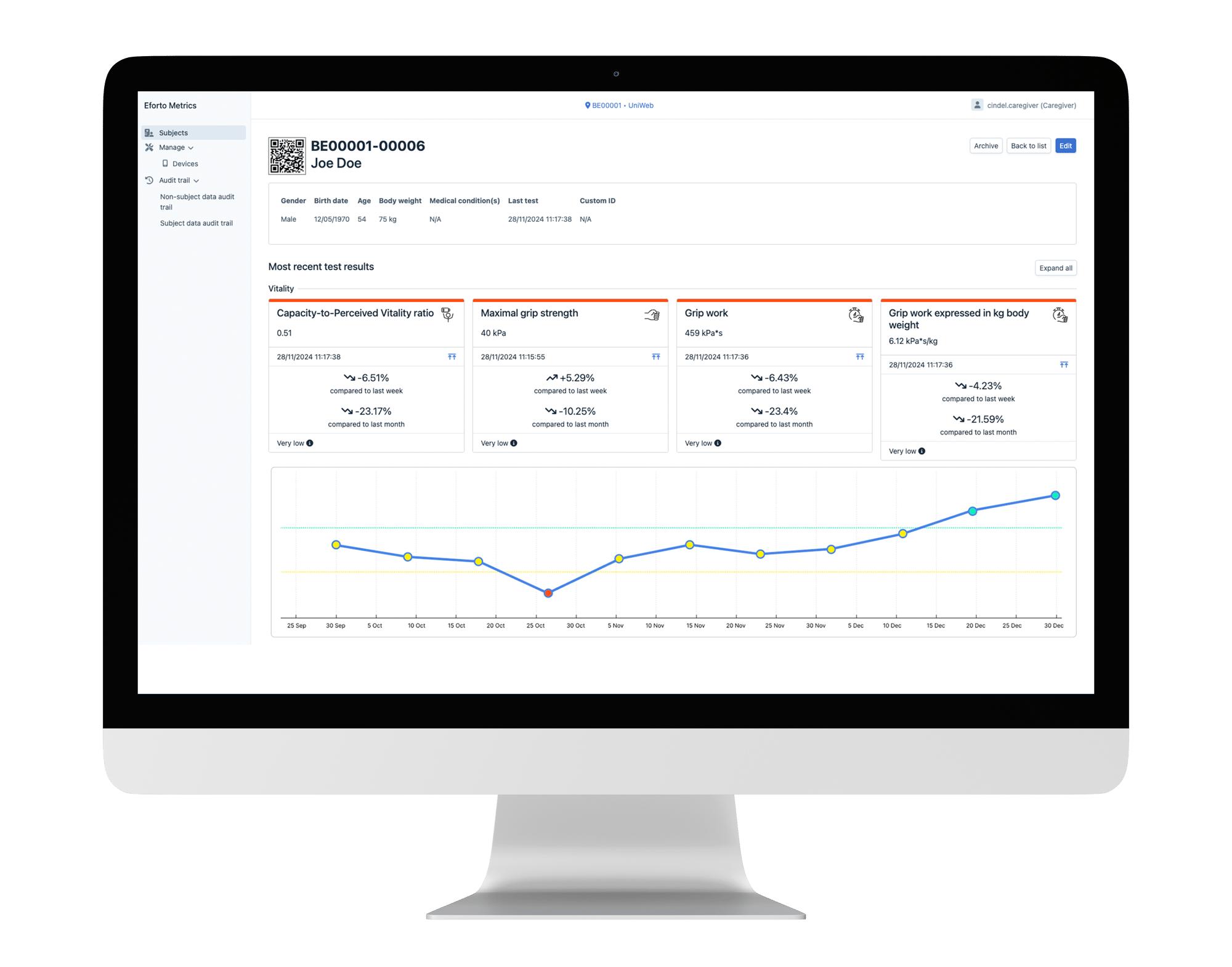
Eforto® Remote Patient Monitoring

Objective muscle health and vitality capacity monitoring - fully integratable into any RPM workflow.

Remote Patient Monitoring (RPM) is widely used for follow-up and chronic care, but most solutions focus on vital signs such as blood pressure, oxygen saturation, or weight.

Muscle health and vitality capacity are rarely monitored, despite being among the strongest indicators of physical resilience, recovery, and long-term health outcomes.1-4 Changes in muscle strength, muscle fatigability, and vitality capacity often precede functional decline or delayed recovery1,4-11 even when traditional vital signs remain stable.

Eforto® Remote Patient Monitoring closes this gap by enabling objective, validated monitoring of muscle health and vitality capacity, using WHO-aligned biomarkers that can be measured safely at home in under five minutes and repeated over time.

Why Remote Monitoring of Muscle Health Matters?

Both prevention and recovery depend on the ability to maintain and restore physical reserves, as described in the WHO Intrinsic Capacity framework.1 Decline in these reserves often starts gradually, increasing vulnerability to health stressors, while insufficient restoration after a stressor can delay recovery and lead to lasting functional loss.

Evidence shows that:

  • Muscle strength reflects neuro-muscular function and overall muscle strength.12
  • Muscle fatigability is a clinical indicator for energy metabolism, resilience and inflammation (IL-6, TNF-α ) 1,13,14 and is predictive of recovery after discharge 4,9
  • Vitality capacity (CPV-ratio) combines muscle fatigability and self-perceived fatigue, enabling early detection of sub-clinical frailty and fatigue.1,10

Because these biomarkers change before deterioration and during recovery, they support both early prevention and objective follow-up. However, without repeatable measurement, decline may go unnoticed and recovery may be assumed rather than measured.

By integrating validated muscle health and vitality biomarkers into remote patient monitoring, Eforto® supports proactive prevention and objective recovery monitoring, enabling timely intervention, optimisation of care pathways, and evaluation of intervention effectiveness across preventive, chronic, and post-acute care settings.

professional-doctor-assistant-checking-medical-rec

How It Works

1

Muscle_Assessment_home

Muscle Assessment
at Home

The patient performs a standardised Eforto® test protocol at home using the Eforto® Vigorimeter and accompanying app. The guided test takes only a few minutes and measures muscle health.

2

Secure_Data_Processing

Secure Data
Processing

Test data is securely transmitted to the Eforto® Metrics platform, where results are processed, benchmarked, and stored in a GDPR- and HIPAA-compliant environment.

3

Remote_Monitoring

Remote
Monitoring

Option 1:
Clinicians use the Eforto® Metrics platform to monitor longitudinal trends, track recovery or decline and support follow-up decisions using objective data.

Option 2:
Eforto® integrates seamlessly into existing RPM ecosystems. Using the Eforto® FHIR-based API, third-party platforms can retrieve Eforto® measurements as structured health data and display muscle health metrics alongside traditional RPM data.

4

Optional_Retesting_icon

Insights & Clinical
Decisions

Clinicians gain longitudinal insight into physical reserves, enabling early detection of decline and objective evaluation of intervention effectiveness.

RPM Deployment Options

Eforto® Remote Patient Monitoring is designed to be flexible and interoperable, allowing organisations to choose the deployment model that best fits their workflows and digital infrastructure.

Eforto-Metrics_Laptop

Use Case 1: Monitoring with Eforto® Metrics

Eforto® Metrics can be used as a complete, stand-alone remote monitoring solution, without requiring integration into a third-party RPM system.

Care teams use Eforto® Metrics to:

  • Monitor individual patients or cohorts over time
  • Track recovery, stability, or early decline
  • Visualise longitudinal trends in vitality capacity, muscle strength and fatigability
  • Share reports with patients and other healthcare professionals
  • Support follow-up decisions using objective data

This option enables fast deployment and is ideal for organisations that don't use any platform yet to perform remote monitoring.

Use Case 2: Integration into your Existing RPM Platform

For organisations with an established RPM infrastructure, Eforto® integrates seamlessly into third-party RPM platforms.

Using the Eforto® FHIR-based API, RPM platforms can:

  • Retrieve Eforto® measurements as structured health data
  • Display muscle health and vitality capacity alongside traditional RPM metrics
  • Use Eforto® data in dashboards, alerts, and clinical workflows
  • Combine muscle biomarkers with vital signs for more comprehensive monitoring

Eforto® is designed as the most integratable muscle assessment solution for RPM.

Monitoring with Eforto Metrics

Benefits

  • Adds muscle health and vitality capacity to RPM
  • Objective, validated biomarkers beyond vital signs
  • Safe, short, home-based self-testing
  • Reduces unnecessary follow-ups
  • Available as a standalone RPM
  • Compatible with existing RPM dashboards
  • Seamless interoperability via the Eforto FHIR API
  • GDPR- and HIPAA-compliant data handling
  • Supports prevention, recovery, and chronic care

Example Use Locations

The flexible setup makes it suitable for:

Hospitals & Outpatient Clinics-new
Hospitals & Post-Discharge Monitoring
Remote follow-up after hospitalisation or surgery

Eforto® enables objective monitoring of functional recovery at home, supporting early detection of delayed recovery and safe follow-up decisions.

Chronic Care & Disease Management Programs
Monitoring resilience in long-term conditions

RPM programs for diabetes, COPD, heart failure, or cancer use Eforto® to track vitality capacity and muscle health alongside traditional vitals.
Fatigue & Recovery Clinics
Objective monitoring of prolonged fatigue and recovery

Fatigue and recovery clinics use Eforto® to objectively track muscle fatigability and vitality capacity, supporting evaluation of treatment response and recovery trajectories.

Longevity Clinic 1
Longevity Clinics
Remote tracking of vitality capacity

Eforto® supports long-term monitoring of vitality capacity to detect early decline and evaluate lifestyle interventions.

Physiotherapy Practices 1
Physiotherapy & Rehabilitation Programs
Home-based recovery monitoring

Therapists track functional recovery remotely between sessions using objective strength and fatigability data.

Customizability & Data Privacy

Eforto® Remote Patient Monitoring supports the following test protocols:

All data is processed via Eforto® Metrics, ensuring secure storage, strict profile separation, GDPR & HIPAA compliance, and FHIR-based interoperability with RPM platforms and other healthcare systems.

“Doing the tests gives me the feeling that I am being looked after, that someone is keeping an eye on me.”
RADBOUD
RadboudUMC
Subject of the FORTO 2.0 study15

Ready to add muscle health to your RPM program?

Extend remote monitoring beyond vital signs and gain objective insight into muscle health and vitality capacity.

Deploy Eforto® Remote Patient Monitoring: stand-alone or fully integrated into your RPM platform.

List of References

  1. Bautmans, I., Knoop, V., Thiyagarajan, J.A., Maier, A.B., et al. (2022). WHO working definition of vitality capacity for healthy longevity monitoring. The Lancet Healthy Longevity, 3(11), e789–e796.
  2. Knoop, V., Costenoble, A., Debain, A., Azzopardi, R.V., et al. (2021). The interrelationship between grip work, self-perceived fatigue and pre-frailty in community-dwelling octogenarians. Experimental Gerontology, 152, 111440.
  3. Westenberger, A., Nöhre, M., Brähler, E., Morfeld, M., et al. (2022). Psychometric properties, factor structure, and German population norms of the multidimensional fatigue inventory (MFI-20). Frontiers in Psychiatry, 13, 1062426.
  4. Swart, M., Geerds, M., Bautmans, I., De Dobbeleer, L., et al. (2024). Association of grip work indicators with post-discharge recovery in geriatric and hip fracture inpatients. Age and Ageing (under review).
  5. Bohannon, R.W. (2019). Grip strength: an indispensable biomarker for older adults. Clinical Interventions in Aging, 14, 1681–1691.
  6. Eldadah, B.A. (2010). Fatigue and fatigability in older adults. PM&R, 2(5), 406–413.
  7. Bautmans, I., Njemini, R., De Backer, J., De Waele, E., et al. (2010). Surgery-induced inflammation in relation to age, muscle endurance, and self-perceived fatigue. Journals of Gerontology Series A, 65(3), 266–273.
  8. Coppers, B., Heinrich, S., Bayat, S., Tascilar, K., et al. (2024). Reduced hand function indicates higher disease activity in patients with rheumatoid and psoriatic arthritis. Annals of the Rheumatic Diseases, 83, 1342.
  9. Gijzel, S.M., van de Leemput, I.A., Scheffer, M., van Bon, G.E., et al. (2019). Dynamical indicators of resilience in postural balance time series are related to successful aging in high-functioning older adults. Journals of Gerontology: Series A, 74(7), 1119–1126.
  10. Peeters, G., Swart, M.M., De Dobbeleer, L., Bautmans, I., et al. (2025). Understanding hand grip measures in geriatric inpatients: associations with frailty, daily functioning and fatigue. Aging Clinical and Experimental Research, 37(1), 293.
  11. Knoop, V., Costenoble, A., Debain, A., Bravenboer, B., et al. (2023). Muscle endurance and self-perceived fatigue predict decline in gait speed and activities of daily living after 1-year follow-up: results from the BUTTERFLY study. Journals of Gerontology: Series A, 78(8), 1402–1409.
  12. Vaishya, R., Misra, A., Vaish, A., Ursino, N., et al. (2024). Hand grip strength as a proposed new vital sign of health: a narrative review of evidences. Journal of Health, Population and Nutrition, 43(1), 7.
  13. Mets, T., Bautmans, I., Njemini, R., Lambert, M., et al. (2004). The influence of celecoxib on muscle fatigue resistance and mobility in elderly patients with inflammation. American Journal of Geriatric Pharmacotherapy, 2(4), 230–238.
  14. De Dobbeleer, L., Beyer, I., Njemini, R., Pleck, S., et al. (2017). Force-time characteristics during sustained maximal handgrip effort according to age and clinical condition. Experimental Gerontology, 98, 192–198.
  15. AAL Programme. (2025, January 9). FORTO 2.0 - AAL programme. https://www.aal-europe.eu/projects/forto-2-0/